Agile Compensation
Agile cells payagile remuneration
agile paymente - competencies based payteams compensation
competencies based compensation
agile paysalary agile scrum
pay for skillsknowledge based compensation
competency compensationcompesation for teams
teams remunerationHow to reward fairly without breaking the team spirit
Agile models require compensation schemes that recognize real differences between people, sustain collaboration, and align collective effort with the value delivered to the business.
The challenge of compensating agile teams
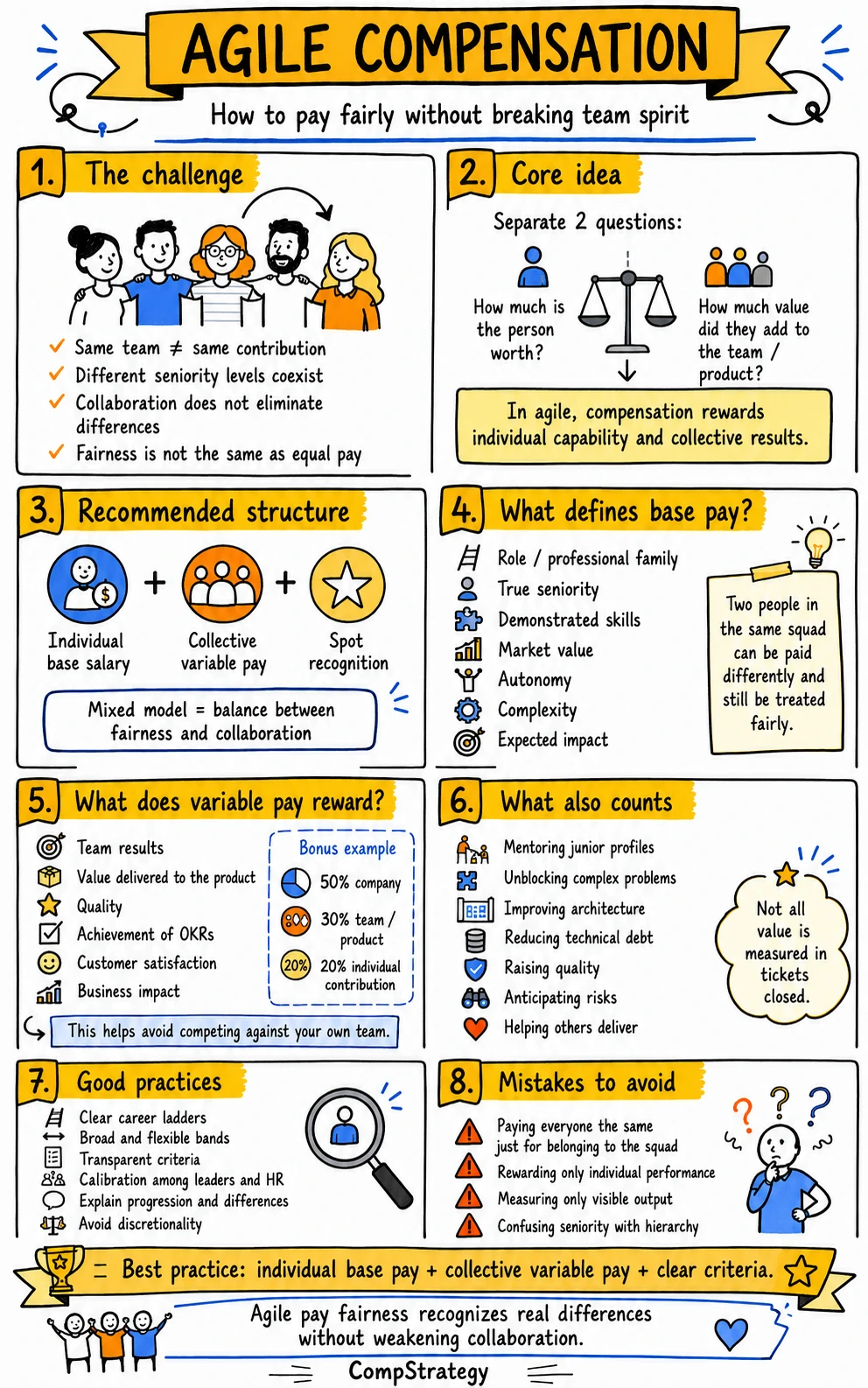
The adoption of agile methodologies creates a relevant challenge for compensation management. In frameworks such as Scrum, people work in multidisciplinary teams, with shared objectives, short delivery cycles, and a strong focus on the value generated for the customer or the business. However, within the same squad, there may be profiles with different levels of seniority, experience, autonomy, critical skills, and contribution. This requires organizations to rethink traditional compensation schemes.
The first key point is to understand that working on the same team does not mean contributing exactly the same. Collaboration is central to agile, but it does not eliminate real differences between people. A senior profile may unblock complex problems, mentor junior profiles, anticipate technical risks, improve architecture, or raise the overall quality of the product. Many of these contributions are not always reflected in simple indicators, such as the number of closed tasks or individual velocity, but they have a significant impact on team performance.
Avoiding the extremes: neither automatic equality nor pure individualism
Therefore, a compensation scheme compatible with agile methodologies should avoid two extremes. On the one hand, paying all squad members the same may create inequity and demotivate those who contribute differentiated capabilities. On the other hand, maintaining purely individual incentives may affect collaboration, encourage internal competition, and weaken shared responsibility for results.
A mixed model to balance equity and collaboration
The most balanced solution is usually a mixed model. Base salary remains individual and should reflect the role, professional family, actual seniority, demonstrated competencies, market value, autonomy, complexity, and expected impact. This makes it possible to recognize legitimate differences between people who are part of the same team. Two members of a squad may be paid differently and still remain within an equitable framework if the criteria are clear, consistent, and explainable.
In contrast, variable compensation can incorporate a more collective logic. Bonuses or incentives may be linked to team results, value delivered to the product, quality, achievement of OKRs, customer satisfaction, and business impact. A limited individual contribution component may also be maintained, especially to recognize differentiated contributions. In this way, people avoid competing against their own team, while the organization also recognizes that not all contributions are the same.
For this model to work, it is essential to have good governance practices: clear career ladders, broad and flexible salary bands, transparent progression criteria, calibration among leaders and Human Resources, and consistent communication about how compensation decisions are made. Fairness in agile does not mean paying everyone the same, but rather recognizing real differences without weakening collaboration.
How CompStrategy can help
CompStrategy can help organizations transition from traditional schemes to compensation models that are more compatible with agile environments. This support may include redesigning the current model, adapting salary structures, analyzing roles and professional levels, defining career ladders, incorporating pay criteria based on competencies or critical skills, and redesigning bonuses and incentives to balance individual performance, team results, and organizational impact.
In addition, CompStrategy can collaborate in building salary administration rules, calibration tools, communication criteria for leaders, and materials that help explain the new approach to the organization. The transition to agile does not require abandoning the technical discipline of compensation, but rather adapting it to a reality in which value is increasingly generated through teams, products, and shared capabilities.
Three principles of a strong agile compensation model
A strong agile compensation model combines three elements: individual base salary, collective variable pay, and clear criteria. This combination makes it possible to support organizational transformation with greater equity, transparency, and effectiveness.
Individual base salary
Recognizes role, seniority, competencies, autonomy, complexity, and expected impact.
Collective variable pay
Aligns incentives with team results, delivered value, and shared objectives.
Clear criteria
Enables transparent decisions, consistent calibration, and internal trust.
Agile compensation is not about paying everyone the same
The goal is to build a model that preserves collaboration, explains pay differences clearly, and connects individual contribution with collective outcomes.