Executive Compensation vs. Traditional Compensation: A Key Difference for Business Strategy
Talking about compensation is not only about salaries. It is about how an organization recognizes contributions, attracts talent, retains critical capabilities, and guides behaviors. However, not all compensation decisions follow the same logic. There is a significant difference between traditional compensation management and executive compensation, and understanding that difference is essential for any company seeking to grow with strength, governance, and strategic focus.
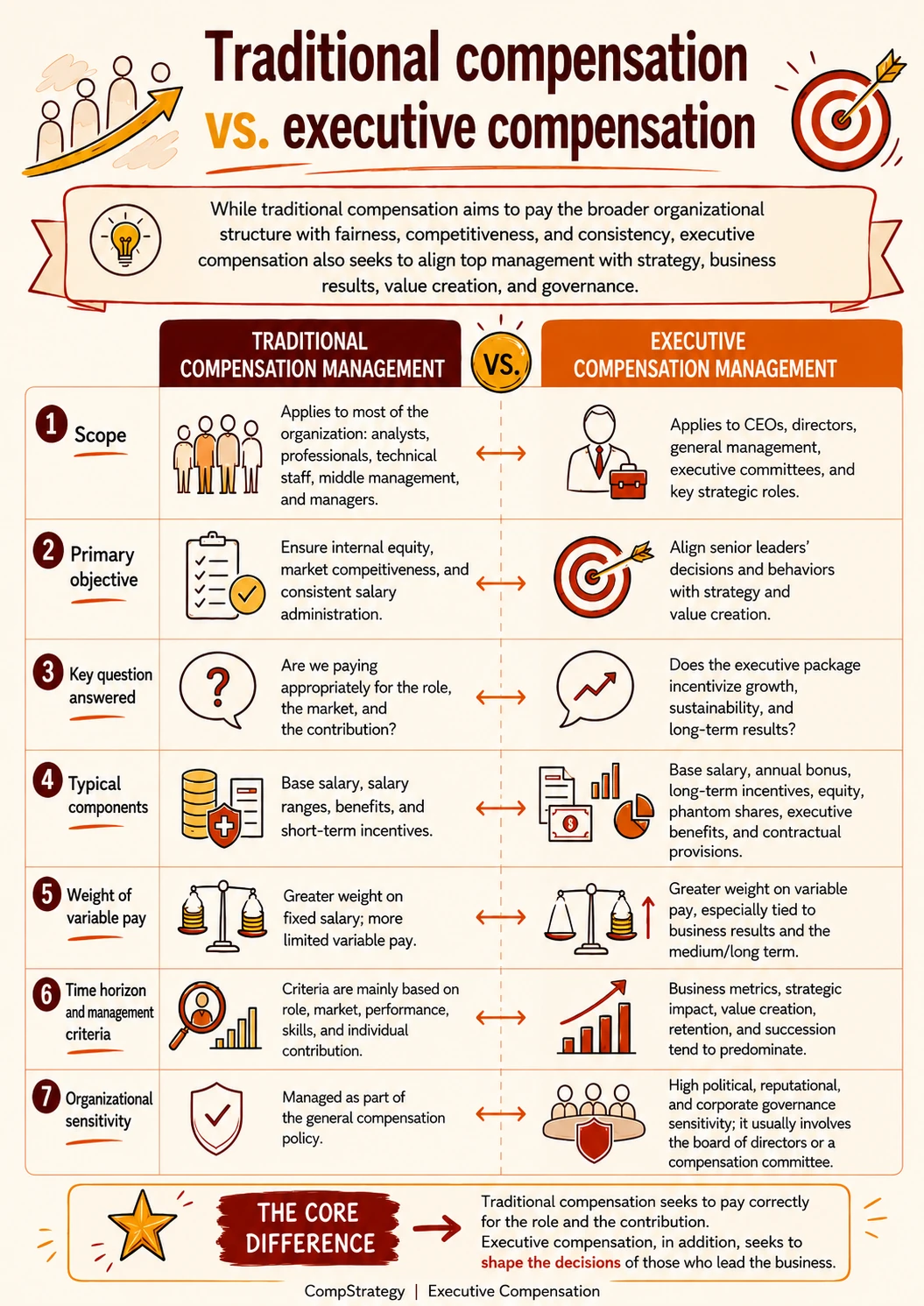
Traditional compensation usually focuses on the broader organizational structure. Its main objective is to manage salaries and benefits in an equitable, competitive, and consistent way, considering variables such as role, market, performance, and individual contribution. In this area, the central question is often: Are we paying correctly for the role and level of contribution?
Executive compensation, by contrast, has a very different scope and level of complexity. It is not only about how much a CEO, director, or member of the executive committee is paid, but about how to design a compensation package capable of aligning leadership decisions with corporate strategy, value creation, business sustainability, and shareholder expectations. Here, the question changes: Does the compensation scheme incentivize the right decisions for the organization’s future?
What makes executive compensation different?
Unlike traditional compensation schemes, executive compensation analysis is not limited to fixed salary. The focus is on total compensation, which may include short- and long-term components, business metrics, specific contractual conditions, executive benefits, and mechanisms for retention or value creation.
- Greater strategic alignment: executive pay must support business objectives and reinforce leadership behaviors consistent with the company’s vision.
- Greater weight of variable pay: annual bonuses and long-term incentives often play a much more significant role than they do across the broader organization.
- Greater institutional sensitivity: executive compensation decisions affect governance, corporate reputation, and relationships with shareholders, regulators, and the market.
- Greater technical complexity: the design must consider benchmarking, metrics, regulatory risks, disclosure, and best practices.
For this reason, executive compensation requires a specialized perspective. A poorly designed scheme can incentivize short-term decisions, weaken the retention of key leaders, or raise concerns regarding equity, transparency, and corporate governance. By contrast, a well-designed scheme becomes a powerful tool for driving sustainable results.
The value of expert management
At CompStrategy, we understand that executive compensation should not be addressed through generic criteria or by simply extending traditional compensation practices. It requires technical depth, business understanding, and an integrated view of strategy, market, and governance. That is why we support organizations in the design, evaluation, and management of compensation schemes for senior executives, ensuring that every compensation decision is well-founded, coherent, and strategically meaningful.
Our services are designed to help companies build solid, competitive, and defensible compensation frameworks, tailored to their specific reality and business challenges.
How does CompStrategy support organizations?
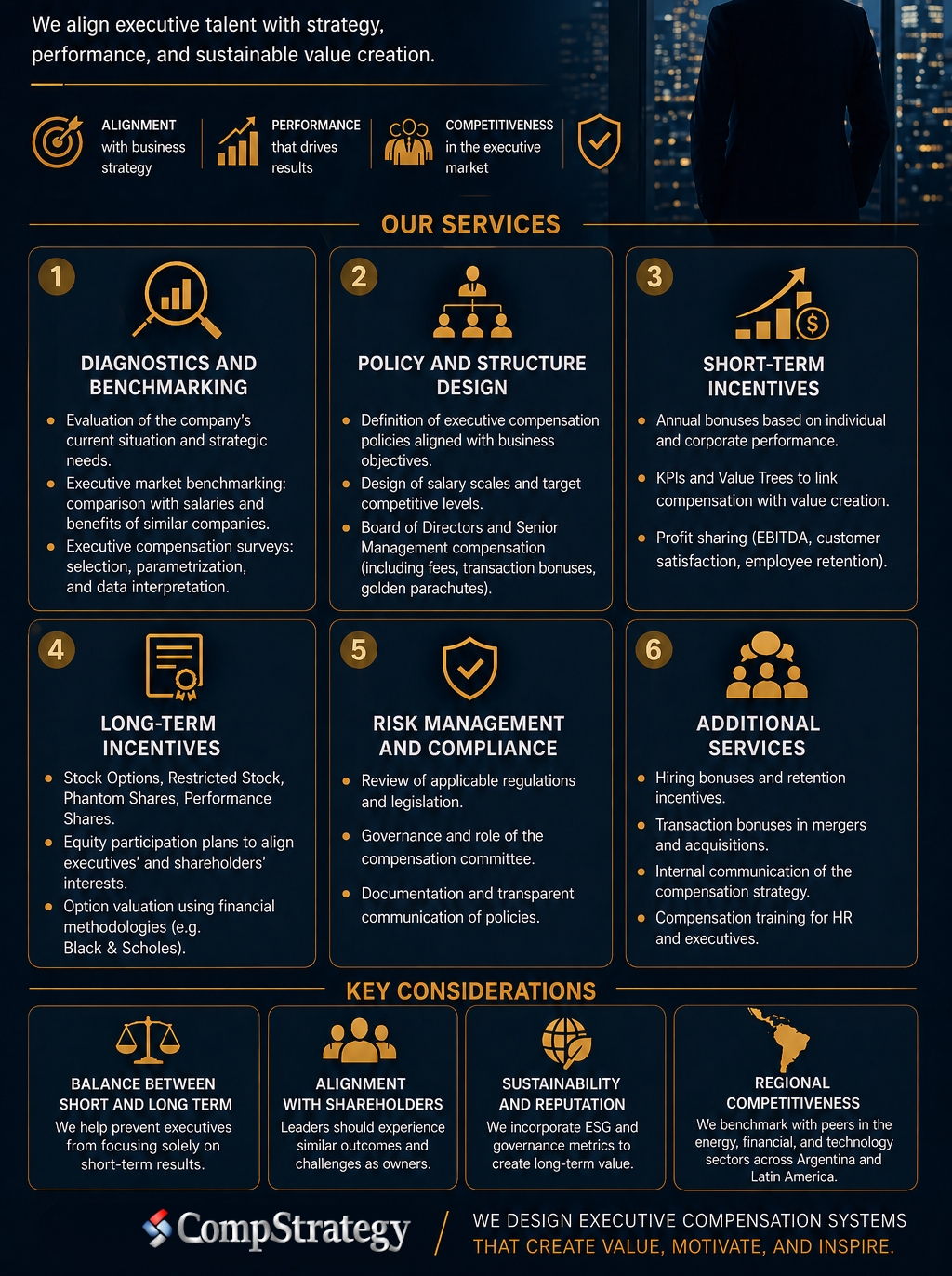
- Design of executive compensation schemes: we develop compensation structures for CEOs, directors, and senior leadership teams, aligned with corporate strategy, value creation, and business sustainability.
- Market benchmarking: we analyze comparable practices, compensation levels, and relevant trends to ensure external competitiveness and market consistency.
- Policy design and review: we define guidelines, eligibility criteria, governance principles, and administration rules that enable executive compensation to be managed with clarity and robustness.
- Short-term incentives: we design annual bonuses and variable pay plans linked to financial, operational, and strategic objectives, with clear and challenging metrics.
- Long-term incentives: we structure mechanisms aimed at sustainable value creation, such as long-term incentive plans, equity, phantom shares, or other formats suited to each organization’s context.
- Analysis and preparation of the Executive Compensation section of proxy statements: we provide technical support for the development, review, and strengthening of this section, ensuring consistency, narrative clarity, disclosure quality, and alignment with market best practices.
- Regulatory risk management: we assess regulatory implications, disclosure risks, and reputational sensitivity to support responsible and well-substantiated decision-making.
- Comprehensive evaluation of executive packages: we analyze the current structure, the mix between fixed and variable pay, the quality of the metrics, and the actual degree of alignment with business objectives.
More than paying: shaping decisions
The most important difference between traditional compensation and executive compensation can be summarized simply: the former seeks to pay correctly for the role and contribution; the latter also seeks to shape the decisions of those who lead the organization.
That difference is decisive. Those who lead a company do not merely perform tasks: they make decisions that affect growth, profitability, innovation, risk management, and market confidence. For this reason, their compensation must be designed with a different logic, capable of balancing attraction, retention, performance, value creation, and governance.
At CompStrategy, we help transform executive compensation into a true management lever. We combine technical expertise, market insight, and strategic understanding so organizations can rely on competitive, consistent, and business-aligned compensation schemes.
If your organization needs to review, professionalize, or redesign its executive compensation practices, CompStrategy can support you with a tailored, rigorous, and results-oriented approach.