Incentives and Bonus
A well-designed annual incentive system is much more than a variable pay mechanism. It is a management tool that connects business objectives with the behaviors, decisions, and results the organization needs to promote. When properly structured, an annual incentive helps translate corporate strategy into concrete, measurable, and actionable goals for business areas, teams, and individuals.
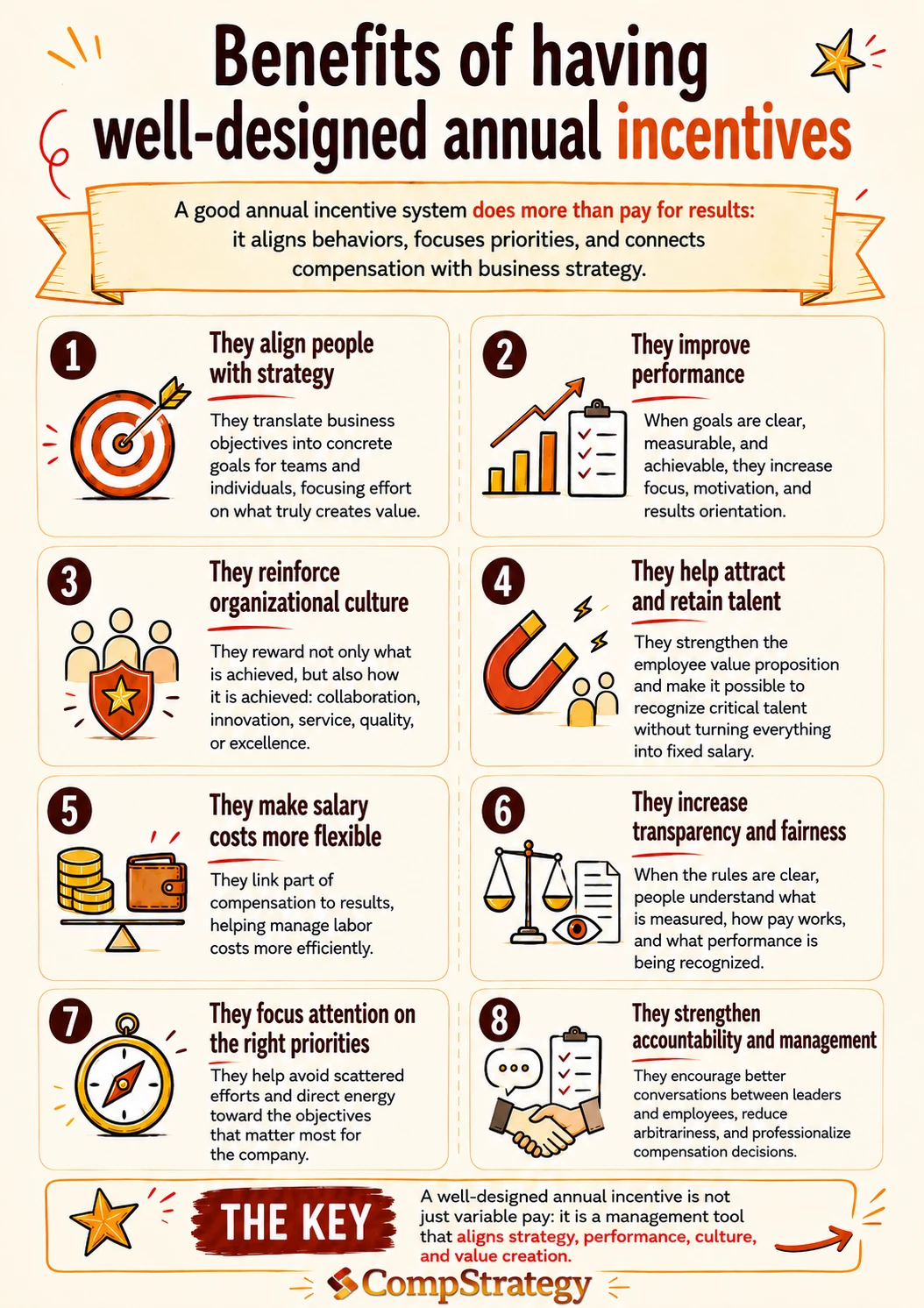
Annual incentives as a key tool for aligning performance, strategy, and value creation
In many companies, annual incentives are used to recognize the achievement of short-term objectives, such as revenue growth, profitability, productivity, operational efficiency, quality, customer satisfaction, completion of strategic projects, or improvement in key indicators. However, their true value does not depend only on the existence of a bonus, but on the quality of its design: which indicators are selected, how they are weighted, which performance levels trigger payment, which population participates, and how the plan is communicated.
Main benefits of having well-designed annual incentives
A good annual incentive system allows variable compensation to function as a bridge between strategy and execution. Among its main advantages are:
- Alignment with business strategy: incentives help convert corporate objectives into specific goals for the organization, business areas, and employees. In this way, effort is focused on what truly creates value.
- Performance improvement: when goals are clear, measurable, relevant, and achievable, people understand what is expected of them and can better orient their decisions and priorities.
- Reinforcement of organizational culture: incentives reward not only what is achieved, but also how it is achieved. They can promote collaboration, customer orientation, innovation, operational excellence, quality, efficiency, or compliance.
- Attraction and retention of talent: a competitive variable compensation plan strengthens the employee value proposition and makes it possible to recognize critical talent without shifting all recognition to fixed salary.
- Greater flexibility in salary costs: by linking part of compensation to results, the company can better manage its labor costs, especially in contexts of volatility or changes in business performance.
- Transparency and fairness: a clear design reduces discretion, improves the perception of internal fairness, and allows employees to understand what is measured, how payment is calculated, and why performance is recognized.
- Focus on the right priorities: incentives help avoid scattered efforts and concentrate the organization’s energy on the most relevant objectives.
- Greater accountability: by establishing goals, indicators, and payment rules, management conversations between leaders and employees are strengthened, professionalizing decision-making in compensation matters.
Design matters: not every incentive creates value
A poorly designed incentive can produce unintended effects. For example, it may reward short-term results at the expense of sustainability, encourage individual behaviors when collaboration is needed, generate payments disconnected from actual performance, or create expectations that are difficult to sustain. For this reason, the technical design of the plan is fundamental.
An effective system must answer key questions: what results should be incentivized?, who should participate?, which indicators will be used?, how will performance be measured?, what weight will each metric have?, what will the minimum, target, and maximum payment levels be? and how will the plan be communicated?
It is also important to define the balance between corporate, business-area, and individual indicators. In some cases, it is advisable to prioritize overall results to reinforce a shared organizational perspective. In others, it is necessary to incorporate specific metrics by function, business unit, or role. The key is to build a plan that is technically sound, simple to administer, and easy to understand.
CompStrategy’s services in Annual Incentives
CompStrategy supports organizations in the design, review, implementation, and management of annual incentive systems, ensuring that they are aligned with business strategy, market best practices, and each company’s organizational reality.
Our services include:
- Diagnosis of existing plans: assessment of the current design, identification of strengths, inconsistencies, risks, and improvement opportunities.
- Design of annual incentive plans: definition of eligibility, metrics, weightings, payout curves, achievement levels, formulas, and activation conditions.
- Market benchmarking: analysis of competitive practices to determine incentive opportunity levels, bonus targets, and market positioning.
- Alignment with strategic objectives: selection of indicators that reflect the real priorities of the business and promote behaviors consistent with the desired culture.
- Economic and budget modeling: simulation of payout scenarios, cost impact analysis, and sensitivity assessment across different performance levels.
- Design of policies and plan documents: development of clear rules, administration criteria, plan governance, and support materials for leaders and employees.
- Communication and implementation: preparation of messages, guides, and presentations to ensure a clear understanding of the plan and strengthen its internal credibility.
- Periodic review and continuous improvement: adjustment of indicators, goals, and payout mechanisms as strategy, the market, or the organizational structure evolve.
Advantages of hiring CompStrategy
Hiring CompStrategy allows companies to address annual incentives with a technical, independent, and results-oriented perspective. Our approach combines compensation expertise, business understanding, quantitative analysis, and organizational sensitivity.
This enables companies to:
- Have clearer, more competitive plans aligned with strategy.
- Reduce risks of inequity, discretion, or payments disconnected from performance.
- Improve transparency and internal communication of the variable compensation system.
- Better manage labor costs and anticipate the financial impact of different scenarios.
- Strengthen the ability to attract, motivate, and retain key talent.
- Professionalize decision-making in compensation and incentives.
In summary, a well-designed annual incentive should not be viewed solely as a bonus. It should be understood as a strategic management tool that helps align people, priorities, performance, culture, and value creation. With CompStrategy’s support, organizations can transform their incentive plans into clear, effective, and sustainable instruments to drive better business results.