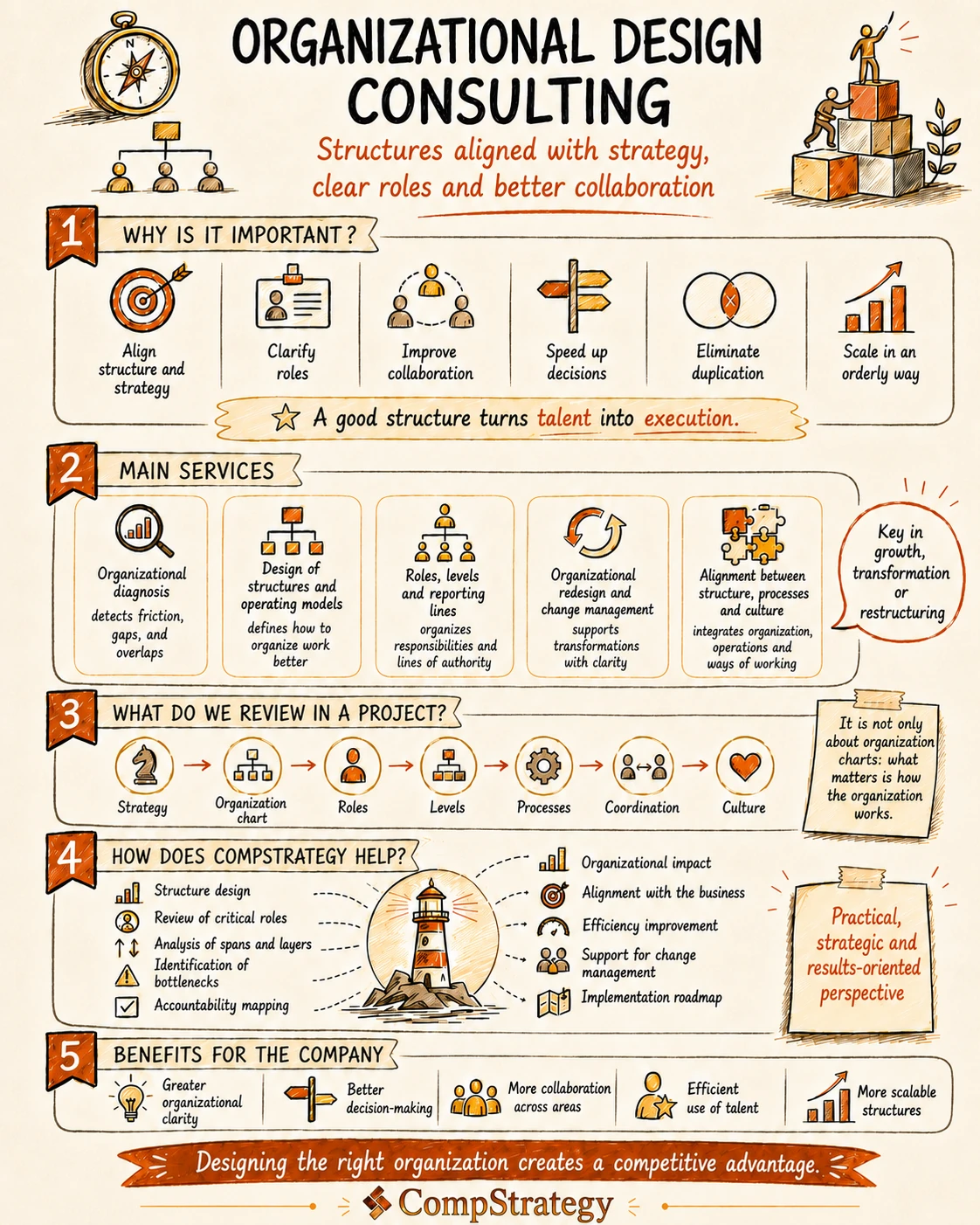
We design structures that organize, align, and empower talent
At CompStrategy, we help organizations design structures aligned with their business strategy, optimizing collaboration, clarifying roles, and maximizing the value of talent. Our approach combines organizational diagnosis, operating model design, role and level definition, organizational redesign, change management, and alignment between structure, processes, and culture.
Organizational structure as a strategic lever
Every organization needs a structure that allows it to execute its strategy with clarity, speed, and focus. However, many companies grow, transform, or incorporate new areas without comprehensively reviewing how responsibilities are distributed, how decisions are made, what levels exist, how teams interact, and where duplications, bottlenecks, or gray areas are generated.
Organizational design is not simply about drawing organizational charts. It involves understanding how the company must operate to achieve its objectives, what capabilities it needs to develop, what roles are critical, how areas should coordinate, and what operating model will generate better results. A good structure facilitates collaboration, accelerates execution, improves the employee experience, and allows talent to be directed toward where it truly creates value.
At CompStrategy, we accompany companies through processes of organizational review, redesign, and evolution, providing an external, methodological, and results-oriented perspective. Our work transforms complex or misaligned structures into clearer, more efficient models that are consistent with the strategy, culture, and priorities of the business.
Main services
Our approach addresses organizational design comprehensively, connecting diagnosis, structure, roles, processes, levels of responsibility, and change management. Each project is adapted to the reality of the organization, its stage of growth, its industry, its culture, and its strategic challenges.
Organizational diagnosis
We analyze the current structure, workflows, distribution of responsibilities, hierarchical levels, coordination mechanisms, and main points of friction. We identify duplications, overlaps, responsibility gaps, bottlenecks, and opportunities for improvement.
Structure and operating models design
We design organizational structures and operating models that facilitate strategy execution. We define grouping criteria, reporting relationships, decision-making scopes, coordination mechanisms, and key responsibilities for each unit.
Definition of roles, levels, and reporting
We clarify roles, responsibilities, organizational levels, reporting lines, and differentiation criteria between positions. This improves internal equity, streamlines decision-making, and strengthens talent management.
Organizational redesign and change management
We support transformation, integration, growth, or restructuring processes, helping to manage impacts on people, teams, leadership, and ways of working. We design roadmaps to implement the changes with clarity and sustainability.
What problems we help solve
Organizations usually turn to organizational design projects when they detect that the current structure no longer adequately supports the business. Common warning signs include slow decision-making, overlapping tasks, lack of accountability, areas working in silos, unorganized growth, unclear roles, or structures that do not reflect strategic priorities.
- Lack of clarity in roles and responsibilities: individuals or areas without defined scopes of action, leading to conflicts, delays, or duplication of efforts.
- Oversized or imbalanced structures: excessive layers, inappropriate spans of control, or inefficient distribution of positions and resources.
- Operating models misaligned with strategy: structures designed for an earlier stage of the business that no longer address current challenges.
- Disconnected processes and structure: organizational charts that do not reflect how work actually flows or how value is generated for internal or external clients.
- Scaling difficulties: rapidly growing companies that need to organize functions, responsibilities, reporting lines, and coordination mechanisms.
- Cultural or strategic changes: organizations that need to adapt their structure to promote greater collaboration, agility, customer centricity, or accountability.
How we work
At CompStrategy, we use a practical, participatory, and decision-oriented methodology. We combine interviews, document analysis, organizational chart reviews, role assessments, workshops, and comparative analysis to build a clear vision of the current model and design viable alternatives for improvement.
| Stage | Objective | Key Deliverables |
|---|---|---|
| 1. Diagnosis | Understand the current structure, its strengths, tensions, and opportunities for improvement. | Organizational map, key findings, critical points, risks, and opportunities. |
| 2. Conceptual design | Define design criteria aligned with the strategy, culture, and business model. | Design principles, structural alternatives, grouping criteria, and reporting. |
| 3. Detailed design | Translate the chosen model into roles, levels, responsibilities, and coordination mechanisms. | Target organizational chart, roles matrix, organizational levels, and key responsibilities. |
| 4. Implementation plan | Prepare the transition to the new model, minimizing risks and resistance. | Roadmap, communication plan, change management, and implementation milestones. |
Benefits for the organization
A good organizational design allows people to better understand their roles, leaders to make decisions with greater clarity, and the company to better utilize its resources. It also facilitates the connection between strategy, structure, processes, culture, and compensation, providing a solid foundation for talent management.
- Greater organizational clarity: better-defined roles, responsibilities, and reporting lines.
- Better decision-making: clearer scopes of authority and accountability.
- More collaboration: reduction of silos and improvement of coordination mechanisms between areas.
- More efficient use of talent: better allocation of capabilities, resources, and critical positions.
- More scalable structures: models prepared to support growth, transformation, or expansion.
- Greater internal consistency: better alignment between structure, levels, roles, processes, culture, and compensation.
CompStrategy: organizational design with a business perspective
At CompStrategy, we help transform the organizational structure into a true platform for strategic execution. Our contribution combines expertise in compensation, organizational design, talent management, and structure analysis, allowing us to build clearer, more efficient models aligned with business objectives. The result is an organization better prepared to collaborate, decide, grow, and generate value.