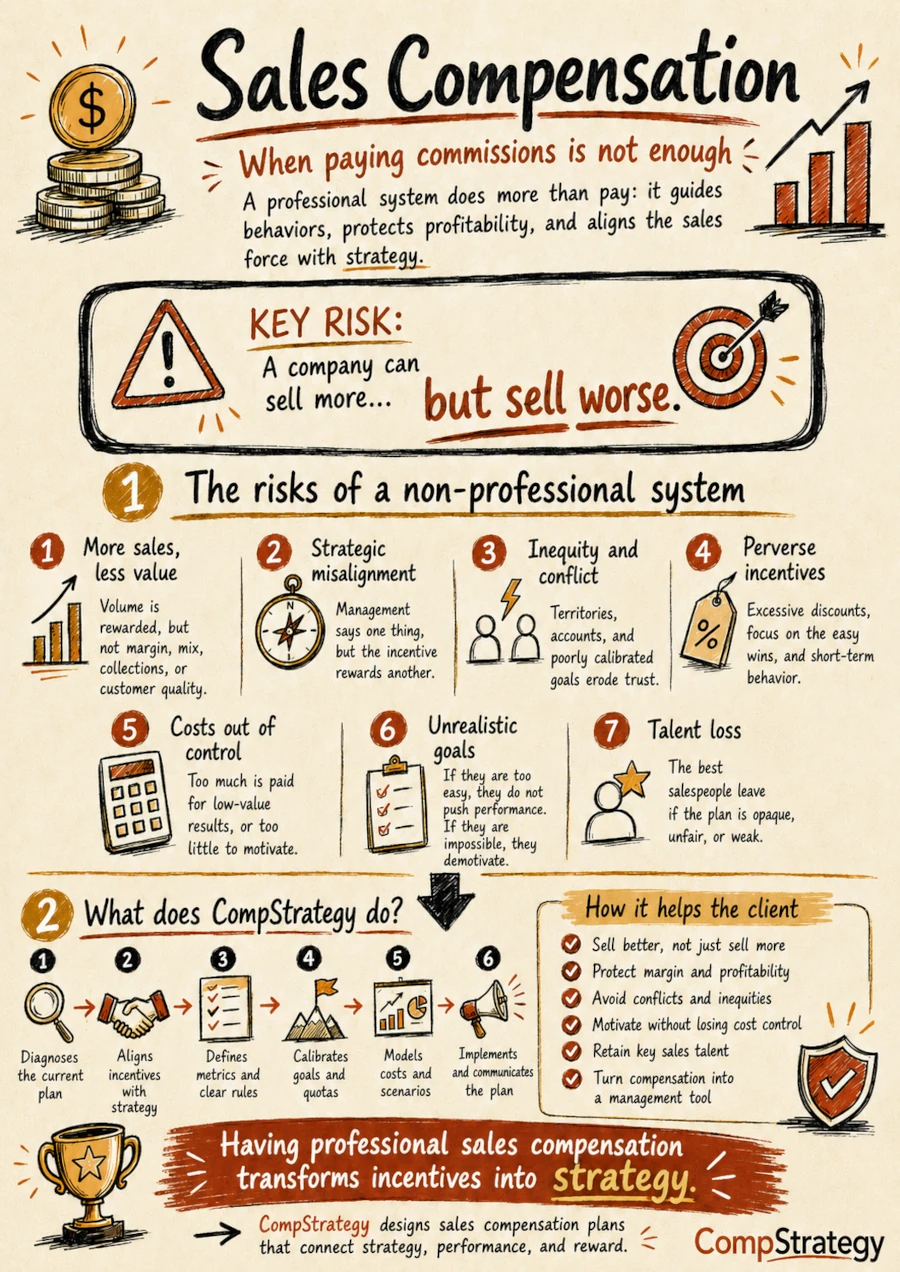
In many organizations, sales force compensation is managed as a purely operational matter: a commission is defined, targets are assigned, and payment is made based on achieved commercial results. However, a sales compensation system is much more than a payment formula. It is a critical tool for direction, communication, and performance management.
The way a company compensates its salespeople directly influences what they sell, how they sell, whom they sell to, with what level of profitability, with what time horizon, and with what degree of alignment with the business strategy. That is why, when the sales force is not managed through a professional compensation system, the organization is exposed to significant risks that can affect its revenue, margins, internal climate, and ability to achieve sustainable growth.
At CompStrategy, we help companies design, review, and implement compensation schemes for sales forces that not only motivate, but also guide the right commercial behaviors, protect profitability, and strengthen strategic execution.
The risk of selling more, but capturing less value
One of the most common problems with poorly designed commercial schemes is that they incentivize volume without sufficiently protecting the quality of the sale. If the plan pays mainly for revenue, units sold, or quota attainment, salespeople may focus on closing deals quickly, even when those sales are not the most convenient for the company.
This can lead to excessive discounts, sales of low-margin products, customers with collection issues, operational commitments that are difficult to fulfill, or a focus on short-term opportunities at the expense of strategic accounts.
The result can be paradoxical: the company sells more, but earns less. Commercial activity grows, but profitability is eroded.
A professional sales compensation system must avoid this imbalance. To do so, it is necessary to define what “selling well” really means for each business. In some cases, it will mean growing revenue; in others, improving margins, developing new customers, promoting strategic products, increasing recurrence, improving collections, or strengthening long-term relationships.
CompStrategy helps translate those priorities into concrete metrics, weightings, and payment mechanisms, so that the commercial force is rewarded for creating value, not only for generating sales.
When compensation contradicts strategy
Commercial compensation communicates. It often communicates even more than speeches, internal presentations, or strategic plans. If management states that the priority is to grow in new segments, but the incentive plan mainly rewards the existing portfolio, the sales force will receive a contradictory message.
The same occurs when the company wants to improve profitability, promote certain business lines, or develop strategic customers, but its commission system continues to reward any sale equally.
When compensation is not aligned with strategy, the organization loses execution capacity. Salespeople do what the system rewards, not necessarily what the business needs.
At CompStrategy, we work with an integrated perspective: we understand the commercial strategy, analyze the business objectives, and design compensation schemes that turn those priorities into observable behaviors. The goal is for each plan variable to have a business rationale and for each incentive to reinforce the desired direction.
Inequity, conflicts, and loss of trust
A non-professional compensation system can also generate significant internal equity issues. In sales, differences in results do not always depend solely on individual effort or talent. They are also influenced by territory potential, portfolio maturity, account allocation, product type, seasonality, brand strength, channel, and the commercial cycle.
When these factors are not properly considered, some salespeople may benefit from structurally more favorable conditions, while others face more difficult targets or less developed portfolios. This often leads to complaints, a sense of arbitrariness, and loss of credibility in the system.
Conflicts over accounts, territories, targets, and commissions consume time from Commercial Management, Human Resources, Finance, and Administration. They also damage the internal climate and can turn the sales force into a group of individual interests competing with one another, instead of a team oriented toward common results.
CompStrategy helps companies review the equity of their commercial plans, properly calibrate quotas and targets, establish clear rules for eligibility, allocation, and payment, and build systems that are perceived as fair, competitive, and administrable.
Perverse incentives: when the system drives undesired behaviors
Salespeople tend to respond quickly to economic stimuli. That is precisely the power of variable compensation plans. But it is also their risk.
Poor design can generate undesired behaviors, such as pulling sales forward from one period to another in order to reach a target, selling with unjustified discounts, prioritizing commissionable products even when they are not strategic, abandoning non-incentivized activities, neglecting collections, or competing internally for customers and opportunities.
In many cases, these behaviors do not arise from bad faith. They are simply rational responses to a system that rewards certain actions and omits others. That is why the technical design of the plan is key.
At CompStrategy, we evaluate the potential behavioral effects of each component of the scheme. We analyze not only how much is paid, but also what behaviors the system may induce. This perspective helps reduce risks, anticipate unwanted effects, and design plans that reward sustainable results.
Cost control and economic sustainability
A good commercial incentive plan must motivate, but it must also be financially sustainable. When the system is not well designed, the company may end up paying incentives that are too high for results that do not generate enough economic contribution, or too low to attract and retain commercial talent.
Both scenarios are problematic. In the first case, the plan erodes profitability. In the second, it loses motivational power and competitiveness in the market.
In addition, poorly professionalized schemes often generate high budget unpredictability. The company does not know precisely how much it will pay under different performance scenarios, nor whether the variable cost will be properly linked to value creation.
CompStrategy helps economically model commercial compensation plans. This makes it possible to simulate scenarios, analyze payout curves, define thresholds, accelerators, caps, self-funding conditions, and expected levels of variable cost. The result is a system that motivates the salesperson while also protecting the business economics.
Poorly calibrated targets: the silent enemy of motivation
A commercial plan may be correctly designed in its architecture, but fail if the targets are poorly defined. Targets that are too easy generate payments without true incremental effort. Impossible targets demotivate and destroy the credibility of the system.
Target calibration is one of the most sensitive aspects of sales compensation. It requires analyzing sales history, market potential, portfolio characteristics, territories, seasonality, pipeline, price changes, product launches, and competitive conditions.
When the sales force perceives targets as arbitrary or unattainable, the incentive loses strength. By contrast, when targets are challenging but reasonable, the system becomes a true performance management tool.
CompStrategy supports companies in defining criteria and methodologies to set commercial targets in a more objective, transparent, and consistent way. This helps improve trust in the system and strengthen the link between effort, results, and reward.
Clarity, communication, and plan administration
A sales compensation system must not only be well designed: it must also be easy to understand, communicate, and administer. If salespeople do not understand how their incentive is calculated, which sales count, when payment is made, what happens with returns, uncollectible accounts, shared accounts, or territory changes, the system loses effectiveness.
The lack of clear rules generates recurring discussions, exceptions, different interpretations, and internal friction. It can also weaken the sales force’s trust in the organization.
That is why a professional plan must include clear documentation, precise business rules, eligibility criteria, mechanisms to resolve special cases, and simple but robust communication.
CompStrategy helps companies not only with the technical design of the plan, but also with its implementation and communication. This includes preparing explanatory documents, governance recommendations, administration criteria, and messages for leaders and sales teams.
Retention of key commercial talent
The best salespeople usually recognize quickly whether a compensation plan is competitive, clear, and fair. If the scheme is opaque, unstable, unattractive, or perceived as arbitrary, the company risks losing valuable commercial talent.
The departure of a key salesperson does not only mean replacing a position. It can mean losing customer relationships, market knowledge, competitive information, negotiation experience, and revenue generation capacity.
A professional compensation system helps attract, motivate, and retain commercial talent, especially when it combines external competitiveness, internal equity, clear rules, and a strong connection with business results.
CompStrategy can help compare the competitiveness of the commercial scheme, assess improvement opportunities, and design compensation proposals that support high-performing sales teams.
From a commission logic to a true commercial compensation strategy
Sales force compensation should not be seen as an expense or as a simple commission mechanism. It should be considered a strategic investment to mobilize commercial energy toward the right objectives.
A professional system helps answer key questions:
- What results do we want to incentivize?
- What commercial behaviors do we need to reinforce?
- How do we balance volume, profitability, growth, and quality of sale?
- How do we ensure equity across territories, portfolios, and roles?
- How do we avoid paying for results that do not create value?
- How do we make the plan clear, motivating, and administrable?
- How do we align sales with the overall business strategy?
These questions require a technical, strategic, and practical perspective. Copying market formulas or applying standard percentages is not enough. Each company needs a design adapted to its business model, commercial cycle, culture, strategy, channel structure, and growth objectives.
How CompStrategy can help
At CompStrategy, we support organizations in the design, evaluation, and implementation of compensation systems for sales forces that are strategic, competitive, equitable, and sustainable.
Our services may include:
- Diagnosis of the current commercial compensation scheme.
- Identification of risks, inconsistencies, and undesired incentives.
- Analysis of competitiveness and internal equity.
- Review of commercial roles, territories, portfolios, and eligibility criteria.
- Design of metrics, weights, payout curves, accelerators, thresholds, and caps.
- Definition of commercial objectives and calibration criteria.
- Economic modeling and simulation of payout scenarios.
- Alignment of the plan with margin, profitability, growth, and strategic priorities.
- Documentation of the plan and administration rules.
- Support in the communication and implementation of the new scheme.
Our approach combines compensation expertise, business perspective, and an understanding of commercial dynamics. The goal is not simply to design a plan that “pays commissions,” but to build a system that helps the company sell better, grow profitably, and strengthen its execution capacity.
Conclusion
A well-incentivized sales force can be one of the most powerful growth engines of a company. But a poorly incentivized sales force can become a source of margin loss, internal conflicts, turnover, undesired behaviors, and strategic misalignment.
The difference is not only in how much is paid, but in how the system is designed, communicated, and administered.
Having a professional commercial compensation system makes it possible to turn sales incentives into a true management tool. It helps guide behaviors, improve results, protect profitability, retain talent, and ensure that commercial energy is focused on what truly creates value.
At CompStrategy, we help companies design compensation schemes for sales forces that connect strategy, performance, and reward. Because selling more is important, but selling better is what makes growth sustainable.