Technical Career Ladders: how to develop and retain critical technical talent
Technical Career Ladders are professional growth models designed to develop, recognize, and retain specialists whose technical knowledge is critical to the business. They allow for a development alternative distinct from the Management Track , preventing highly valuable professionals from having to become managers to continue growing within the organization.
For Human Resources, Talent, Compensation, and Organizational Development areas, the design of Technical Career Ladders is a strategic tool for preserving critical knowledge, building successors, organizing expertise levels, defining technical competencies, and linking professional growth with responsibility, recognition, and compensation.
At CompStrategy, we help companies design and implement Technical Career Maps, policies, and development models that allow them to retain critical technical talent, strengthen internal capabilities, and align talent management with business strategy.
What are Technical Career Ladders?
A Technical Career Ladder is a formal professional development architecture associated with a specific technical discipline that is central or essential to value creation. Its objective is to preserve specific, scarce, and strategically relevant knowledge within the company to ensure sustainability, operational continuity, and business competitiveness.
Unlike traditional career plans, which often concentrate growth in supervision or team leadership positions, Technical Career Ladders recognize that some individuals provide their greatest contribution by deepening their expertise, solving complex problems, transferring knowledge, and guarding capabilities that cannot be easily replaced in the market.
Why companies need Technical Career Ladders
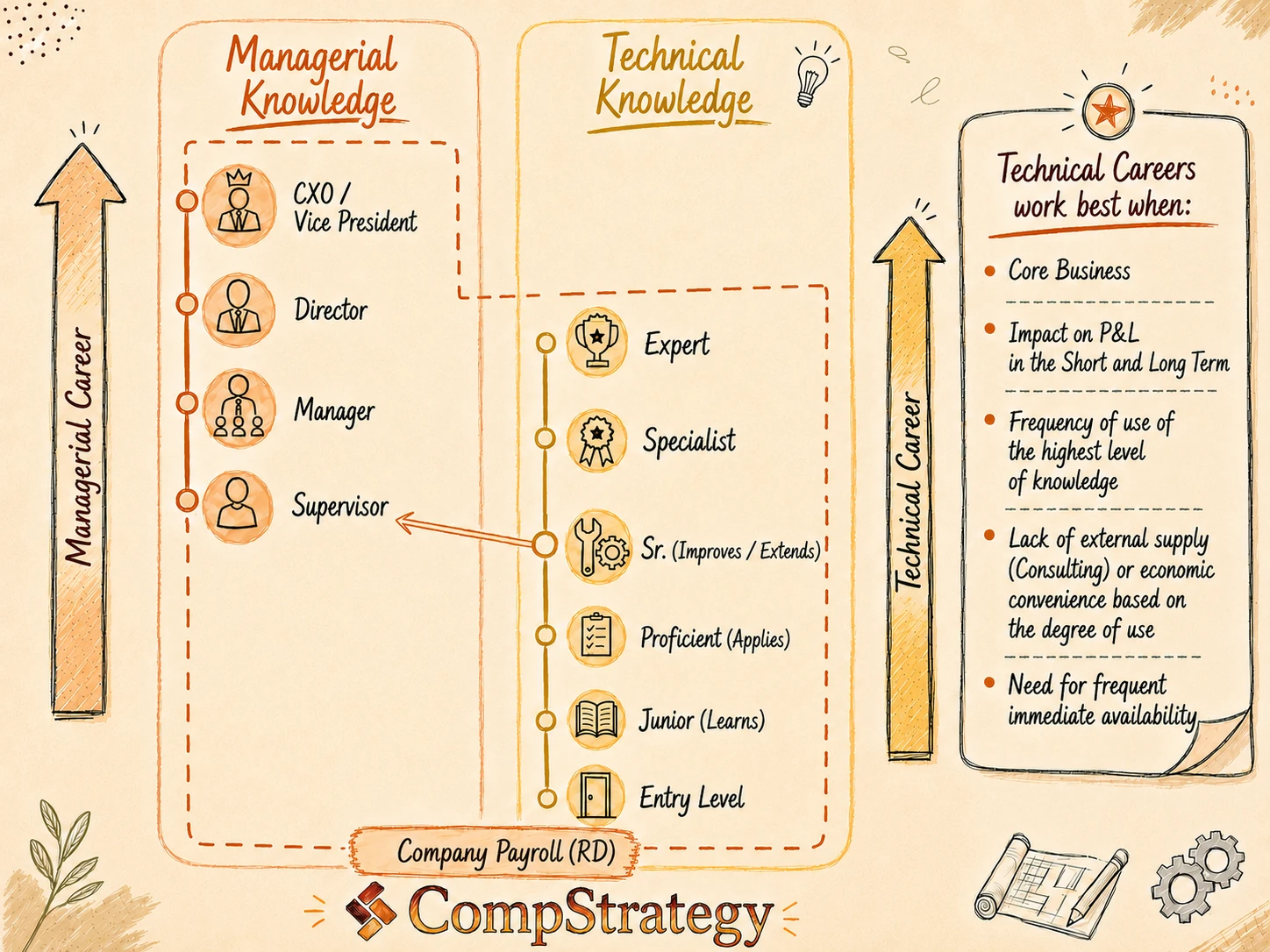
The use of Technical Career Ladders becomes especially relevant when the required technical talent is not available in the market, is too expensive, or requires long periods of internal maturation. In these cases, relying exclusively on external consultants or specific hires may be insufficient, risky, or economically inefficient.
The central criterion is not simply whether technical knowledge is useful, but whether that knowledge is critical to the business, difficult to replace, and necessary to sustain the organization's competitive advantage. When the answer is yes, the company needs a deliberate strategy to develop, retain, and recognize its specialists.

The risk of losing critical technical knowledge
Consider the case of a midstream engineer with years of experience in the operation, maintenance, and optimization of hydrocarbon transport, compression, measurement, and storage systems. Over time, this professional knows not only formal procedures but also technical criteria, operational risks, regulatory restrictions, historical learnings, and practical decisions that allow the infrastructure to function safely, efficiently, and continuously.
If the only way to grow within the company were to assume a management position, this engineer might face a common dilemma: move toward people supervision, even when their primary vocation and greatest contribution lie in technical depth, or seek opportunities outside the organization where their expertise is recognized as a professional career in itself.
For the company, losing such a specialist doesn't just mean replacing a position. It can mean the loss of accumulated knowledge, expert judgment, technical memory, diagnostic capability, and mastery of critical processes. In knowledge-intensive industries, this loss can affect safety, efficiency, operational continuity, and future innovation capacity.
Technical Track vs. Management Track
The Management Track is oriented toward people leadership, team management, organizational decision-making, and resource coordination. The Technical Track, on the other hand, is oriented toward deepening expert knowledge, solving complex technical problems, transferring capabilities, and contributing directly to the business's technical excellence.
Both tracks can have equivalent levels of importance, recognition, and compensation, but they respond to different types of contributions. The key is to avoid making "becoming a boss" the only way to progress, especially when the person provides greater value as a technical specialist.
When to implement Technical Career Ladders
Not every technical function requires a formal Technical Career Ladder. The model is especially recommended when expert knowledge is critical to strategy, not easily available in the market, requires long learning periods, or represents a concrete source of competitive advantage.
Technical Career Ladders are particularly valuable when the organization needs to:
- Retain critical technical talent that might leave the company due to a lack of development opportunities.
- Preserve specialized knowledge that is difficult to replace or outsource.
- Build a succession strategy for key technical experts.
- Recognize specialists who do not wish to move into managerial roles.
- Organize levels of expertise, responsibility, authority, and compensation.
- Communicate which knowledge, competencies, and experiences are truly valuable to the business.
Benefits of Technical Career Ladders for HR and the business
A well-designed Technical Career Ladder model transforms expert knowledge into a manageable organizational capability. It's not just about creating new titles or levels, but about building a clear architecture to develop specialists, recognize critical contributions, and strengthen business continuity.
- Specialist retention: offers growth opportunities to technical professionals who might leave if they don't find internal development.
- Knowledge preservation: helps maintain scarce and difficult-to-replace technical capabilities within the company.
- Development clarity: makes explicit what knowledge, competencies, experiences, and results are necessary to advance.
- Better succession planning: allows for the identification of replacements and the construction of technical talent pipelines.
- Greater internal equity: differentiates levels of technical contribution without relying exclusively on hierarchical positions.
- Alignment with compensation: facilitates linking technical levels with recognition, remuneration, authority, and responsibility.
- Motivation for excellence: by relating career advancement to performance, expertise, and contribution, it reinforces behaviors of high value to the business.
How a Technical Career Ladder is implemented
Implementing a Technical Career Ladder requires a formal process that allows certain employees to join, develop, and advance toward higher levels of responsibility, authority, recognition, and compensation. Once they meet specific requirements, professionals can be considered for promotions within the Technical Career Ladder.
The first step is to verify the strategic need for a Technical Career Ladder in a given discipline. It is common to find companies trying to use this model simply as a way to grant salary increases to people who are "capped" in their salary scale or who will not be promoted in the Management Track. That should not be the central purpose. For those cases, other salary management, recognition, or development tools exist.
A Technical Career Ladder only adds value when it responds to a real business need: protecting critical knowledge, developing specialists, reducing replacement risks, strengthening internal capabilities, and offering an attractive growth proposal for key technical professionals.
Technical Career Map or Matrix
The central tool for managing this model is the Technical Career Map or Technical Career Matrix. This matrix allows for organizing technical development levels, describing required knowledge, defining competencies, establishing training activities, and linking each level with responsibilities, authority, recognition, and compensation.
A well-designed Technical Career Map helps HR and business leaders make more consistent decisions regarding the development, promotion, succession, and remuneration of technical specialists.
Specifically, the Technical Career Map or Matrix allows for:
- Identifying the technical profiles needed to feed a specific Technical Career Ladder.
- Defining the different expertise levels within the track.
- Identifying an individual's degree of development within the Technical Career Ladder.
- Determining objective criteria to reflect career progress.
- Documenting and communicating the required knowledge, competencies, experiences, training, and development activities.
- Associating each level with responsibilities, authority, recognition, and remuneration levels.
- Facilitating succession management and the development of replacements for critical technical positions.
Common errors when designing Technical Career Ladders
For a Technical Career Ladder to work, it must be designed with conceptual rigor, clear criteria, and strong alignment with business strategy. Some common errors can weaken the model or turn it into a merely administrative tool.
- Implementing Technical Career Ladders without a real strategic need.
- Using them only to resolve salary situations for people capped in their band.
- Copying models from other companies without considering one's own business reality.
- Not clearly differentiating between technical contribution and managerial leadership.
- Creating levels without objective advancement criteria.
- Failing to link the model with performance, compensation, and recognition.
- Failing to adequately communicate the purpose, scope, and rules of the Technical Career Ladder.
How CompStrategy helps in the design of Technical Career Ladders
At CompStrategy, we accompany organizations in the design and implementation of Technical Career Ladders aligned with business strategy, talent management, and compensation architecture.
Our work can include diagnosing critical disciplines, designing the Technical Career Map, defining levels, competencies, and progression criteria, developing eligibility and promotion policies, and integrating the model with compensation, performance, recognition, and succession planning.
The goal is to build a solid, applicable, and sustainable tool that allows for retaining key specialists, preserving critical knowledge, and offering consistent professional growth paths for those who provide value through technical depth.
Frequently Asked Questions about Technical Career Ladders
What is a Technical Career Ladder?
A Technical Career Ladder is a professional growth model that allows specialists to advance in responsibility, recognition, and compensation without needing to assume a management position.
What is the difference between a Technical Track and a Management Track?
The Management Track focuses on people and team leadership. The Technical Track focuses on deepening expert knowledge, solving complex technical problems, and critical business contribution from a specialty.
When is it advisable to implement Technical Career Ladders?
It is advisable to implement them when the company needs to preserve critical technical knowledge, retain key specialists, develop internal capabilities, or build successors for difficult-to-replace technical disciplines.
What is a Technical Career Map?
It is a tool that defines development levels, knowledge, competencies, responsibilities, training activities, and advancement criteria within a Technical Career Ladder.
Should Technical Career Ladders be linked to compensation?
Yes. For the model to be effective, technical levels must have a clear relationship with responsibility, contribution, recognition, and remuneration. Compensation must accompany the differential value the specialist brings to the business.
Does your company need to design a Technical Career Ladder?
At CompStrategy, we can help you diagnose if a Technical Career Ladder is necessary, design the Career Map or Matrix, define levels and advancement criteria, and align the model with compensation, performance, and talent management.
If your organization needs to retain critical technical talent, preserve expert knowledge, or build a solid alternative to the Management Track, we can accompany you in designing a professional, clear solution aligned with your business.