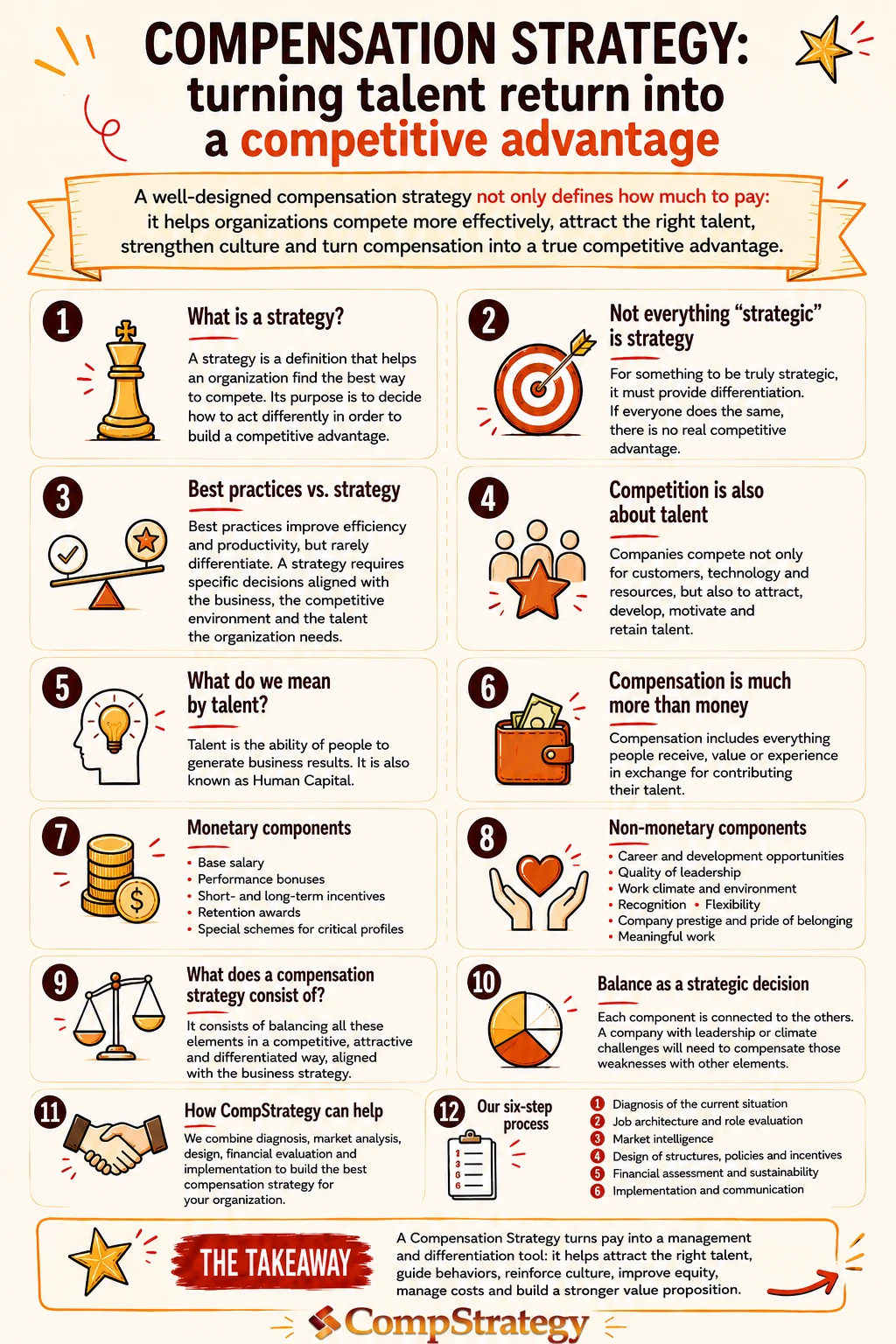
A well-designed compensation strategy does not only define how much to pay: it helps the organization compete more effectively, attract the right talent, reinforce culture, and turn compensation into a true competitive advantage.
What is a strategy?
A strategy is a definition that helps an organization find the best way to compete. Its purpose is not simply to organize actions, but to decide how to act differently in order to build a competitive advantage.
That is why having a strategy is relevant in any environment where competition exists: in games, in sports, in war and, of course, in business.
Not everything “strategic” is strategy
In everyday practice, the word “strategy” is often used imprecisely. Many times, in order to make an initiative sound more important, the adjective “strategic” is added to it. But something does not become strategic simply because it is relevant, costly or visible.
For a definition to be truly strategic, it must provide differentiation. If all organizations do the same thing, there is no real competitive advantage.
Best practices vs. strategy
Best practices can be very valuable: they help improve efficiency, organize processes, reduce risks and increase productivity. But, on their own, they rarely create differentiation.
Copying what others do may bring a company closer to the market standard, but it does not necessarily allow it to compete better. A strategy, on the other hand, requires making specific decisions aligned with the business reality, the competitive context and the type of talent the organization needs.
Competition is also about talent
From this perspective, the Compensation Strategy plays a central role. Companies do not compete only for customers, technology, markets, capital or productive resources. They also compete to attract, develop, motivate and retain talent.
This competition becomes increasingly relevant in contexts where critical capabilities are scarce, people’s expectations change and the retention of key profiles has a direct impact on business results.
What do we mean by talent?
For the purposes of a compensation strategy, we can define talent as people’s ability to generate business results. This ability can also be understood as Human Capital: a combination of knowledge, experience, skills, effort, judgment, commitment and time placed at the service of an organization.
When a person works for a company, they invest their Human Capital in a given employer. In return, they expect to receive a return. That return is compensation.
Compensation is much more than money
Compensation should not be understood in a limited way. It is not reduced to base salary, bonuses, incentives or the benefits package. It includes everything a person receives, values or experiences in exchange for contributing their talent.
That is why a modern view of compensation must consider both monetary and non-monetary components.
Monetary components
- Base salary
- Performance bonuses
- Short- and long-term incentives
- Retention awards
- Special schemes for critical profiles
Non-monetary components
- Career and development opportunities
- Quality of leadership
- Work climate and work environment
- Recognition
- Flexibility
- Company prestige and pride of belonging
- Meaningful work
What does a Compensation Strategy consist of?
A Compensation Strategy consists of balancing all these elements in a competitive, attractive and differentiated way. It is not about paying more in every case, copying what the market does or applying universal formulas.
It is about defining which value proposition the organization needs to build in order to compete for the right talent, in a sustainable way and aligned with its business strategy.
Balance as a strategic decision
Each compensation component has its own role, but it is also connected to the others. A company with a very strong career proposition may not need to compete exclusively on salary. An organization with a highly prestigious employer brand may attract talent even if it does not always pay the highest market rates.
Conversely, a company with leadership, climate or workload issues will likely need to compensate for those weaknesses through other elements: higher salaries, retention bonuses, differentiated benefits or stronger recognition mechanisms.
How can CompStrategy help?
At CompStrategy, we help organizations design a compensation strategy with an integrated, technical and practical perspective. Our approach combines diagnosis, market analysis, structure design, financial assessment and implementation.
1. Diagnosis of the current situation
The process begins with a review of the current compensation proposition. We analyze how it is structured, how competitive it is against the market, what internal inequities exist and which are the main risks related to attraction, motivation or retention.
- Current compensation composition.
- External competitiveness against the market.
- Internal equity across roles, levels and areas.
- Critical talent segments.
- Risks of turnover, demotivation or loss of competitiveness.
2. Job architecture and role evaluation
We then work on job architecture and role evaluation to understand precisely what each position contributes, its relative weight within the organization and how the salary structure should be organized.
This step makes it possible to build solid foundations for consistent, transparent decisions aligned with the real complexity of each function.
3. Market intelligence
We also develop market intelligence to identify each organization’s true talent competitors. These do not always coincide with commercial competitors: a company may compete for customers in one sector while competing for talent with companies from entirely different industries.
Understanding this dynamic is essential to define an appropriate and competitive salary positioning.
4. Design of structures, policies and incentives
Based on the diagnosis and market analysis, CompStrategy designs concrete solutions to organize and strengthen compensation management.
- Salary structures and bands by level, role or job family.
- Salary review policies aligned with performance, market and budget.
- Incentive schemes for the short and long term.
- Performance, attraction or retention bonuses.
- Programs for executives, critical areas or key profiles.
- Compensation models for agile environments or more horizontal structures.
5. Financial assessment and sustainability
Each recommendation is evaluated not only from the perspective of external competitiveness and internal equity, but also based on its financial impact. A good compensation strategy must be attractive to talent, but also feasible and sustainable for the organization.
6. Implementation and communication
Finally, we support the implementation and communication of the strategy. A compensation policy must not only be well designed: it must also be understood.
When the rules are clear, people understand what is valued, how it is rewarded and which behaviors or results drive growth.
Compensation as a competitive advantage
In summary, a Compensation Strategy makes it possible to turn pay into a management and differentiation tool. When well designed, it helps attract the right talent, guide behaviors, reinforce culture, improve equity, manage costs and build a stronger value proposition.
At CompStrategy, we help compensation move beyond being merely an economic obligation and become a true competitive advantage.